
Custom palletizing robots:
throughput is set by the automation, not by the robot
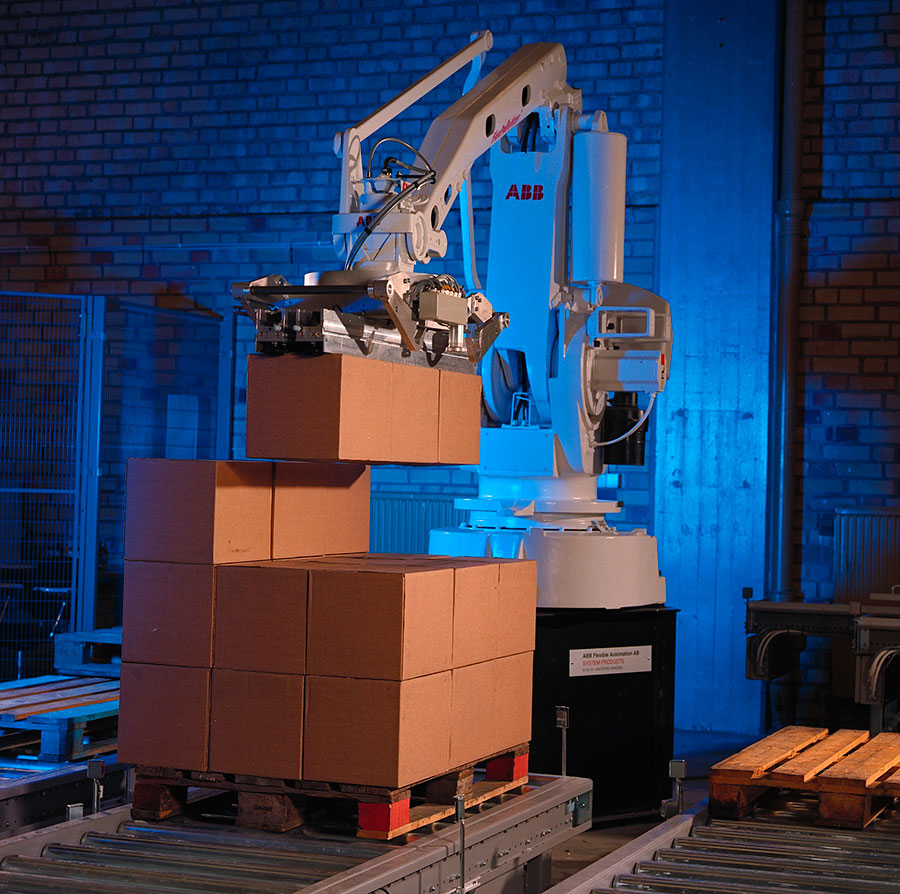
Custom-built automatic palletizing robots
When a customer comes to us for a palletizer, they almost always start with the robot. That is natural: the robot is the part you can see, the arm that moves. But the robot is in fact the part that decides least.
A robot does exactly what the automation around it tells it to do. The throughput of a palletizing line is not set by the arm: it is set by how the automation around it has been designed.

Box palletizing robot

Bag palletizing robot

Palletizing robots for other products
Our experience
That is why we do not pick the robot first and then see what throughput it gives. We work the other way round: we start from what the customer needs to palletize and at what rate, and size the complete solution from there. The robot is one more part of a project that also includes the gripper, the empty pallet feed, the slip sheets and the connection to the customer’s upstream lines.
The gripper and the payload are where it is decided. A robot is identified by the weight it moves, but that figure has to include the gripper itself: a mechanical gripper for two or three boxes already weighs around 60 kg before anything else. That is why a palletizing application rarely comes in under 140 kg of payload — 140 to 200 kg is the usual range — and when full layers have to be handled you move up to robots of 300 to 500 kg.
A real example: a customer went from 8 to 14 units per minute without changing the robot. What changed was the automation — an automatic pallet dispenser was added so the arm no longer had to pick up the empty pallet, and that freed up cycle time.
In another case, a customer who went from 8-9 to 20 per minute did need a different robot: handling full layers meant the payload had to go from 190 to 500 kg.
The same apparent problem — “I want to go faster” — with two different solutions; and in one of the two the robot was never touched.
That is what we bring: the whole picture. A palletizing robot is not a catalogue machine, it is a project that has to take on your production, fit in your plant and connect to the production lines you already have. Designed properly, the robot performs. Sized badly, no arm will fix it however powerful it is.
Palletizing robots
Bottlenecks at the end of your line? At Rivas Robotics we transform your palletizing process with automated solutions that combine advanced technology, flexibility and efficiency. Our palletizing robots are designed to fit the specific needs of your production — boxes, bags or other products — and to integrate cleanly into your production line.
Why a palletizing robot is the best place to start automating
The most repetitive, most physically demanding processes are always the first candidates for automation. Practically every industry has a palletizing operation at the end of the production line, which makes it one of the most common and most cross-cutting needs across industrial sectors.
Palletizing is not only a heavy physical load on operators: it also limits productivity, process consistency and the plant’s capacity to grow. For that reason, putting in a palletizing robot is usually the natural first step into industrial automation.
Palletizing robots
A leader in industrial palletizers
Without question, the installation we are asked for most is palletizing automation. Rivas Robotics has years of experience with palletizing robots for many different products. From low output to very high output, we offer the right palletizing solution to secure one of the key processes in almost any industry.
Tell us what you need to palletize, how many lines you have and at what rate, and we will tell you which palletizing configuration fits your production.


Let's size your palletizing installation
Four pieces of information and we can tell you where the project stands: product, number of lines, throughput and, if you have one, a plant layout.
Download the catalogue
Download our catalogue and see everything we can do.
Industrial palletizer manufacturing
Automation built to measure
Every project is unique, and at Rivas Robotics we develop the automation around each customer’s real needs. Robot manufacturers supply the equipment, but they do not carry out the integration or the commissioning of the installation.
If what you need is not to build pallets but to load and unload a machine, take a look at our machine tending robots. And if you need the opposite — emptying pallets at the start of the line to feed production — that is a depalletizing robot.
Our work is to analyse the production process, size the solution correctly and design a palletizing cell that meets the customer’s production, safety and scalability targets.
We work with the leading industrial robotics manufacturers — Yaskawa, KUKA, FANUC and ABB — selecting in each case the most suitable robot for the application.
Typical specifications of a palletizing project
Every palletizing project is designed from scratch, but the table below shows the most common configurations as a rough guide.
| SPECIFICATIONS | BASIC | OPTIMAL | MULTIPLE |
|---|---|---|---|
| Production lines to palletize | 1 line | 2 lines | 3 or 4 lines |
| Payload | Up to 1,000 kg | Up to 1,000 kg | Up to 1,000 kg |
| Palletizing height | Up to 2,700 mm | Up to 2,700 mm | Up to 2,700 mm |
| Product types | Boxes, bags, packs, cans and special products | Boxes, bags, packs, cans and special products | Boxes, bags, packs, cans and special products |
| Robots used | Yaskawa, KUKA, FANUC, ABB | Yaskawa, KUKA, FANUC, ABB | Yaskawa, KUKA, FANUC, ABB |
| Automatic slip sheet dispenser | Optional | Optional | Optional |
| Automatic empty pallet feeder | Possible, subject to project study | Possible, subject to project study | Possible, subject to project study |
| Automatic stretch wrapper for finished pallets | Optional | Optional | Optional |
To get a solution matched to your process, tell us the four pieces of information above and we will come back with a more detailed proposal.
Throughput we have achieved
These are rates reached on installations already delivered and running in production. Each one corresponds to a specific product, format and automation design.
| Product | Throughput achieved | Installation in production |
|---|---|---|
| Boxes and trays | Up to 25 boxes/min | A single robot serving 3 production lines |
| Bags | Up to 15 bags/min | Salt bags, 2 lines at 15 bags/min |
| Bales | Up to 14 bales/min | 14 bales/min with automatic pallet dispenser |
| Bottles, packs, cans, drums and special formats | Depends on product | Steel drums handled with a KUKA robot |
Robot reach: up to 3,300 mm. See our specific pages on box palletizing, bag palletizing and palletizing difficult products.
Add-ons to a palletizing cell
A palletizing cell can be complemented with a number of auxiliary systems that raise the level of automation and the efficiency of the process:
- Automatic slip sheet dispenser.
- Automatic handling of empty pallets by the robot itself.
- Automatic pallet dispenser, which cuts dead time.
- Automatic stretch wrapper to wrap the pallet once it is complete.
- Labelling systems, integrated before or after palletizing.
Adding these elements turns the installation into a complete end-of-line solution, fully automated and ready for high production volumes.
At Rivas Robotics we help you design, size and complete your palletizing project so that it fits your company’s needs today and the ones you will have later.
Frequently asked questions about robotic palletizing
What is a palletizer?
A palletizer is a system that automatically places whatever comes off your line — boxes, bags, bales or whatever the product is — onto the pallet, and leaves it built and ready to ship.
You will see the same machine called several things: automatic palletizer, industrial palletizer or palletizing robot. They are not different things: they are different technical options for solving the same process. Which one suits you depends on your product, your production rate, the space available in the plant and other variables.
Why are 4-axis robots ideal for palletizing?
4-axis robots are designed specifically for palletizing applications. They are models optimised to work at high speed, with repetitive movements and continuous cycles, delivering reliability and efficiency over the long term.
Their technical characteristics allow them to:
- Handle heavy loads.
- Reach palletizing heights of up to 2,700 mm, and higher on certain projects.
- Hold high throughput with excellent accuracy and repeatability.
That combination makes them the most efficient solution for end-of-process lines.
What palletizing speed can a robot reach?
It depends on the product, the format and the automation around it, which is why the answer is given per project and not from a catalogue.
The rates we have achieved on installations already in production are in the table on this page: up to 25 boxes/min, up to 15 bags/min and up to 14 bales/min.
To estimate yours we need to know what output you require and what format you work with.
Is there a weight limit in robotic palletizing?
Weight is not a problem in robotic palletizing. The range of palletizing robots starts at 80 kg of payload and goes beyond 1,000 kg, always counting both the product to be palletized and the weight of the gripper.
In practice, a palletizing application is rarely solved below 140 kg: the gripper on its own already weighs in the order of 60 kg.
During the design phase, Rivas Robotics selects the most suitable robot based on several variables: total weight, reach, required speed, product type and the space available in the plant.
When the production rate is high, the robot can handle several products simultaneously in a single cycle. That strategy makes it possible to hit the cycle times the process requires. Bear in mind, though, that the more units handled per movement, the larger and heavier the gripper gets — which means a robot with a higher payload.
How much does a palletizing robot cost?
It depends on the level of automation, not on the robot.
Based on our own installations, there are three investment brackets, all of them turnkey: robot, gripper, pallet feed, safety, integration with your line and commissioning.
- €95,000 to €150,000 — palletizing one or two lines, with the pallet on the floor or with the robot loading the empty pallets itself, plus slip sheets. The solution for small and medium output.
- €150,000 to €250,000 — automatic pallet dispenser, slip sheets and several lines or formats in the same cell. The optimal solution, with the most added value.
- Over €250,000 — a complete end of line (stretch wrapper or bundler, weight checking and labelling, pallet evacuation) or high-payload robots for palletizing full layers.
All our robots are new.
To give you a firm figure we need three things: what product, how many lines and at what rate.
What is a palletizing pattern and why does it matter?
One of the key aspects of any palletizing project is the palletizing pattern — the way the product is laid out on the pallet.
Optimising cycle time depends to a large extent on getting the pattern right. A good design lets you:
- Cut out unnecessary movements.
- Improve pallet stability.
- Raise the overall productivity of the line.
A robot can handle anything from a single unit to a full layer in one movement, depending on the product, the format and the production targets.
Do you need a different gripper for every format?
Grippers are not off-the-shelf: they are designed around the specific products in your plant.
Most plants run several formats at once — boxes, bags or bales of different sizes and weights — and the gripper is sized for that range, not for a single product. In bag palletizing, for example, one gripper handles the 10, 25 and 50 kg formats.
Changing product family is a different matter: a gripper for boxes, a fork gripper for bags and one for shrink-wrapped packs are genuinely different tooling. That is why the first thing we need to know is what product you are going to palletize.
Where there are very different products in the same plant, we run a more detailed study to see what solution fits that specific project.
Which products cannot be palletized with a robot?
Very few. If it is palletized by hand today, it can be automated: boxes, bags, bales, trays, shrink-wrapped packs, bottles or jerrycans.
The clear exception is big bags: they are not palletized with a robot because they do not go on a pallet — they are bulk bags handled a different way.
The practical rule is simple: whatever is already being palletized by hand is a candidate for automation. Whatever is not palletized in the first place is not going to be palletized by a robot either.
What do you need to know to tell whether my project is viable?
Four things, and with those the scope of the project is already visible:
- What product you are going to palletize. A rigid box is not the same as a bag or a bale.
- How many production lines you have. One system can serve one, two or three.
- Your throughput. How many boxes, bags or units per minute.
- Layout. Not essential, but a plant layout showing where the palletizing robot has to go is a big help.
With those four answers we can tell you where the project stands. Without them, any figure you are quoted is not worth much.
Can you palletize with a cobot?
For simple processes, at low speed and with light weights, yes. But palletizing usually calls for payload and throughput above what a cobot delivers, and there the limit is not the make of the robot: it is reach and payload.
Palletizing robots
Featured videos
BOX AND TRAY PALLETIZING ROBOT
HIGH-SPEED BOX PALLETIZING ROBOT
SPECIAL PALLETIZING ROBOT
SHRINK-WRAPPED PACK PALLETIZING ROBOT
HIGH-OUTPUT BAG PALLETIZING ROBOT