
Machine loading and unloading
Machine tending robots for loading and unloading
Contact us
A machine tending robot does not build a pallet: it loads and unloads machines.
It is an intermediate step inside your production line, where the part goes into a press, a CNC machine, a cutter or a press brake, and comes out towards the next step. A pallet may be involved, but as a pick or place point, not as the finished product.
We work mainly with raw materials and bulky parts: plastic, metal, wood, board, glass and stone.
2,000 kg
The heaviest we have handled
10 parts/min
Average throughput
4 × 3 m
Sheets we feed into CNC machines
Robot or gantry
Decided by weight and speed
What we solve
Machine loading
We feed presses, CNC machines, cutters and press brakes with the part placed and oriented.
Machine unloading
We take the finished part off and leave it at the next point in the process, on a pallet or on a conveyor.
Parts that cannot be handled by hand
Sheets and boards three and four metres long, and loads that no person can move because of weight or size.
Sectors and real examples
Plastics
Feeding 3 × 2.5 m and 4 × 3 m sheets into CNC machines. One of our most common applications.
Wood and furniture
Doors and components fed into machining centres.
Metal
Loading and unloading metal sheets on a press brake.
We also work with glass and stone.

Robot handling board parts after a cutting machine (wood and furniture).
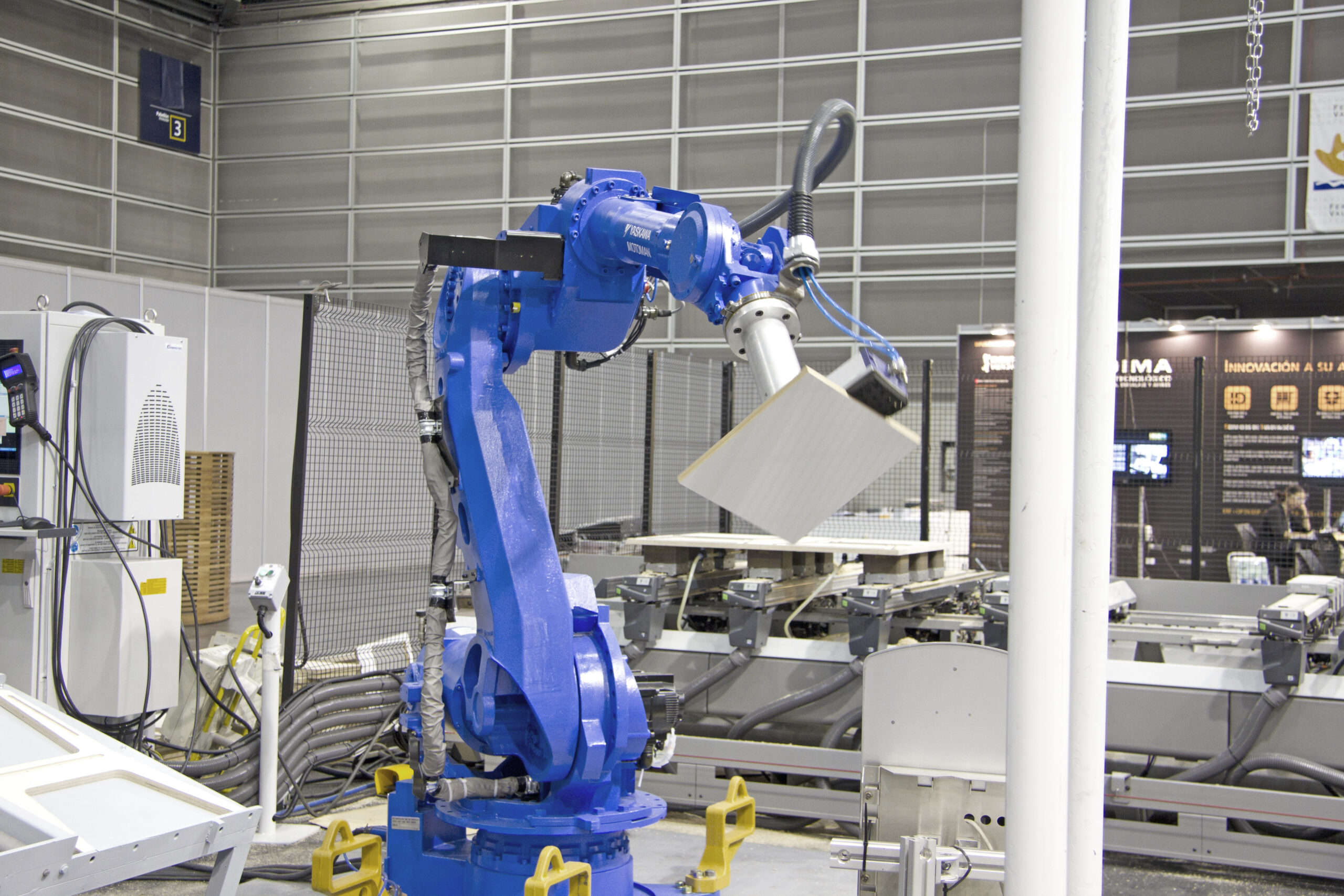
Robot loading wooden doors into a machining centre with a suction cup gripper.
The gripper
The gripper is the most critical element of the project.
Handling a board is not the same as handling a metal sheet, and neither is the same as a pane of glass. Each one is designed around the real part, and it is what decides whether the cell works or gives you trouble every day.
Why it gets automated
In loading and unloading, the reason is almost never speed.
It is size: parts three or four metres long that simply cannot be handled by hand. And it is ergonomics: even if an operator can lift the part, doing it hundreds of times a day takes its toll. The usual reference for manual handling of loads is 25 kg, and many of these parts are far above that.
Frequently asked questions about machine tending robots
How is a machine tending robot different from a palletizing robot?
In what it is for. The palletizer builds the pallet at the end of the line, normally with boxes or bags, and usually in the food industry. The machine tending robot loads and unloads machines inside the production process, with larger, heavier parts, and is mostly seen in plastics, metal, wood and glass. In machine tending the pallet is not the product: it is the place the part is picked from or left on.
How much weight can a robot handle?
The usual range is 500 to 1,000 kg, and it goes up to 1,500 or 2,000 kg. The heaviest we have handled is 2,000 kg. There is no lower limit: payload is sized in each project and it is rarely the problem.
Robot or cartesian gantry?
Two things decide it: weight and speed. Weight is the main constraint. And for high throughput, the gantry is usually a better solution than the robot. One or the other is chosen per project, not by preference.
How many parts per minute are handled?
The average is around 10 parts per minute, lower than in palletizing. But throughput is rarely the constraint: it is sized to whatever your process needs.
Which gripper is used?
It depends entirely on the part. A board is not a metal sheet, and neither is a pane of glass. The gripper is designed around your real product, and it is the most critical element in the whole project.
When is automating a machine load not worth it?
When two things come together: low output and light weight. If the parts weigh 5 to 9 kg and the volume is not high, the operator feeds the machine without difficulty and the investment does not add up. We will tell you that rather than sell you a cell you will never pay off.
If your parts are small and what you are after is speed, that is a pick and place robot.
Tell us what the part is, what it weighs and which machine it goes into, and we will tell you whether your process can be automated and with what.